

If you manufacture bags, luggage, outdoor gear, or apparel—and you buy metal zippers in bulk—you already know the stakes. A failed zipper means product returns, brand damage, and lost contracts. But sourcing the right custom metal zipper from China isn't just about finding the lowest price per piece. It's about matching gauge, finish, slider mechanism, and quality standards to your exact application. This guide walks you through the procurement process end-to-end, so you can make informed decisions and avoid the most common sourcing mistakes.
1. Define Your Specification Before Contacting Suppliers
Most sourcing delays happen because buyers can't clearly articulate what they need. Before sending your first inquiry, nail down these six parameters:
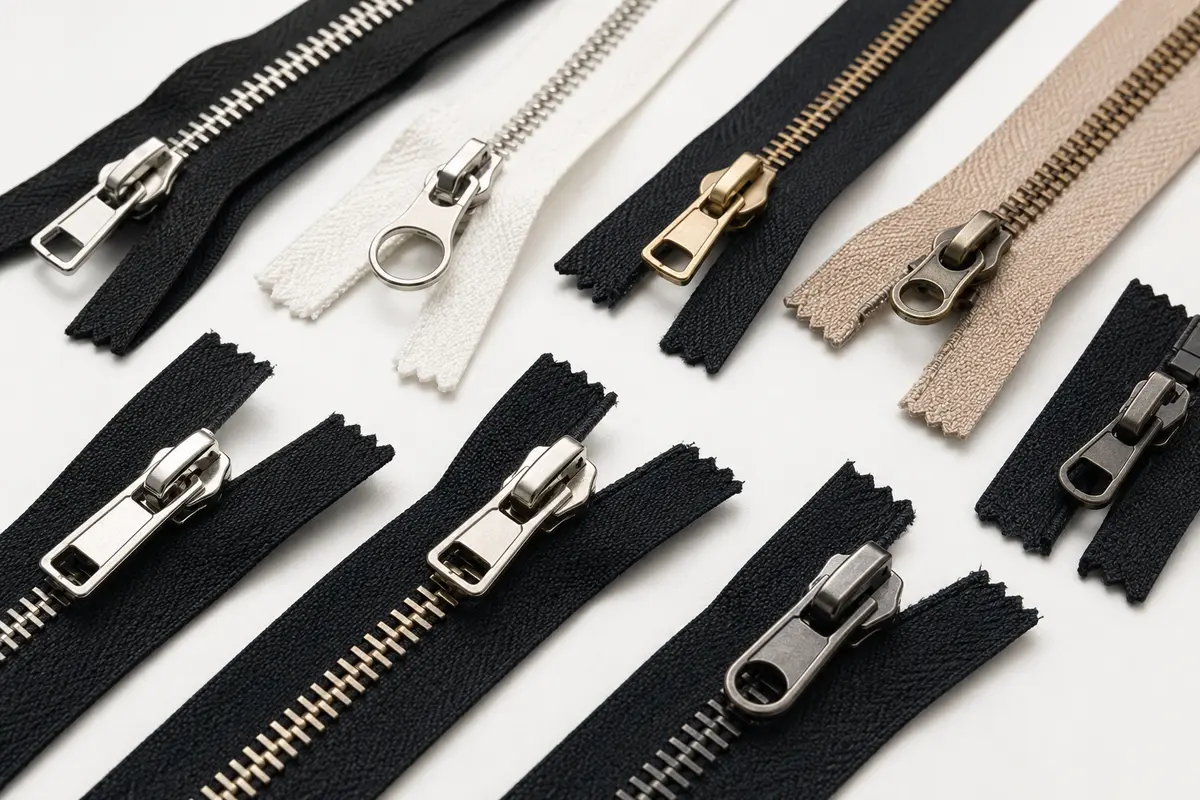
- Zipper Gauge: #3 (lightweight bags, cosmetic pouches), #5 (jackets, mid-weight bags, tents), #7 (luggage, heavy outdoor gear), #8 and #10 (industrial, military, marine canvas). The gauge directly affects strength, durability, and the look of the final product.
- Teeth Material: Brass (classic gold-toned, corrosion-resistant), aluminum (lightweight, silvery), zinc alloy (durable, takes plating well), iron (budget option, prone to rust without coating).
- Slider Type: Auto-lock (self-locking when puller is released — ideal for bags and luggage), non-lock (free-sliding — for garments), pin-lock (manual locking — for heavy canvas and marine), reversible (double-sided — for reversible jackets and tents).
- Puller Design: Standard puller, fancy/decorative puller, rubber-coated puller, long-tab puller for gloved hands. Puller design affects both ergonomics and brand perception.
- Surface Finish: Raw/antique brass, nickel-plated, gunmetal (black oxidized), antique copper, gold-plated, painted. Each finish has different durability and aesthetic properties.
- Tape Material & Color: Polyester (standard, good strength), cotton (vintage look, less durable). Tape color should match or complement your product's fabric.
2. Understand MOQ and Pricing Structure
Metal zipper factories in China typically operate with a minimum order quantity (MOQ) of 1,000 to 5,000 pieces per size/color for custom orders. Standard stock zippers may have lower MOQs. Pricing is influenced by:
- Gauge size: Larger gauges (#7, #8, #10) cost more due to more material per unit.
- Slider complexity: Auto-lock sliders are more expensive than non-lock; multi-component sliders (like the 5-component auto-lock) cost more than 3-component versions.
- Finish type: Electroplating adds cost. Gunmetal and antique finishes require additional processing steps. Nickel-free plating (EU REACH compliant) costs a premium.
- Puller customization: Custom-shaped zinc alloy pullers require mold development ($200–$500 one-time fee), while standard pullers incur no tooling cost.
- Length customization: Standard lengths are cheaper. Non-standard or very long zippers (over 36 inches) may carry a surcharge.
A ballpark figure for a #5 brass zipper with auto-lock slider and standard puller, in quantities of 5,000–10,000 pieces, ranges from $0.15 to $0.35 per piece FOB depending on specifications.
3. Quality Standards You Should Demand
Don't take "good quality" at face value. Require measurable standards:
- ISO 9001: Minimum baseline for factory quality management. Most reputable zipper factories in China hold this certification.
- OEKO-TEX Standard 100: Essential if your products are sold in the EU or to brands that require chemical safety certification for textile components.
- RoHS / REACH: Required for EU market access. Ensures no restricted heavy metals (lead, cadmium, mercury) in metal components or plating.
- Physical Testing: Request test reports for crosswise strength (tape pull), slider locking strength, reciprocation endurance (10,000+ cycles for commercial-grade), and salt spray corrosion resistance (48–96 hours minimum).
4. The Sampling and Prototyping Stage
Never place a bulk order without going through samples first. Here's the recommended sequence:
- Existing Sample Review: Ask the supplier to send their existing stock samples that are closest to your specification. This lets you evaluate baseline quality at minimal cost.
- Custom Pre-Production Sample (PPS): Once you're satisfied with the baseline, request a pre-production sample made to your exact specification. Expect to pay $30–$80 for the sample plus shipping ($20–$50 via DHL/FedEx).
- Golden Sample Approval: Approve the PPS in writing and designate it as the "golden sample" — the quality benchmark against which bulk production will be measured.
- Production Sample Pull: During bulk production, request random samples pulled from the production line for your approval before shipment.
5. Avoiding the 5 Most Common Sourcing Mistakes
After years of working with zipper buyers, these are the errors we see most frequently:
- Mistake #1: Ordering by picture alone. A zipper that looks identical in a photo may perform differently. Always test physical samples on your actual product.
- Mistake #2: Ignoring slider-locking force. An auto-lock slider with insufficient locking force will slide open under load. Specify the locking force requirement (e.g., ≥40N for luggage zippers).
- Mistake #3: Overlooking tape shrinkage. Polyester tape can shrink during washing or heat exposure. Request pre-shrunk tape if your products undergo washing or heat treatment.
- Mistake #4: Mixing incompatible finishes. A gunmetal slider on a nickel-plated chain may look mismatched. Specify finish consistency across all zipper components.
- Mistake #5: No third-party inspection. For orders over $5,000, invest $200–$300 in a third-party pre-shipment inspection (SGS, Bureau Veritas, or Intertek). It's cheap insurance.
6. Logistics and Lead Time Planning
Typical production lead time for custom metal zippers is 15–25 days after sample approval, plus shipping time. Budget for:
- Express shipping (DHL/FedEx): 5–7 days, suitable for samples and small orders under 30 kg.
- Air freight: 7–12 days, cost-effective for 30–200 kg orders.
- Sea freight (LCL/FCL): 25–40 days, economical for orders over 1 cubic meter.
Plan your procurement timeline at least 60–90 days ahead of your production deadline to allow for sampling, production, inspection, and shipping.
7. Building Long-Term Supplier Relationships
The best zipper suppliers aren't transactional vendors—they're strategic partners who understand your product line and anticipate your needs. Look for suppliers who:
- Offer design suggestions based on your product category (luggage, outdoor gear, apparel)
- Provide stock management and just-in-time delivery programs
- Communicate proactively about material price fluctuations (brass and zinc prices can shift)
- Maintain consistent quality across reorders
- Have English-speaking sales staff for smooth communication
A reliable zipper supplier is one of the most valuable relationships in your supply chain. Invest the time to find the right one, and your products—and your customers—will thank you.
Ready to source your custom metal zippers? Explore our full range of metal zippers, sliders, and pullers — manufactured to international quality standards with full customization options available.